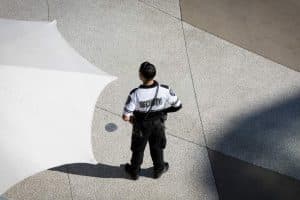
Not all security posts are created equal. A guard stationed at a shopping mall faces a completely different set of challenges than one working an overnight construction site or posted in a hospital behavioral health unit, and treating those assignments as equivalent is one of the most common and costly assumptions in the security industry.
Understanding how security guard needs differ by industry is essential for any security company managing multiple client environments. The physical environment, the nature of the threats, the legal framework governing the space, and the training required to handle incidents correctly all vary significantly from one sector to the next.
For security guard companies, getting that match right isn’t just good operations. It directly affects your liability exposure, your contractual obligations, and whether your insurance program covers what happens on your worst day. When incidents occur in environments for which guards weren’t properly prepared, the investigation that follows almost always focuses on whether the right resources were deployed with the right training to the right site.
Here’s a sector-by-sector breakdown of what each environment demands, and what it means for your operations and coverage.
Retail: Theft Prevention, Crowd Management, and the False Arrest Problem
Retail environments put guards in a uniquely difficult position. They’re open-access, high-traffic spaces where the primary security threat, including both opportunistic shoplifting and increasingly sophisticated organized retail crime, must be addressed without turning the customer experience into an adversarial one. That tension creates real decision-making pressure, and the consequences of getting it wrong can be significant.
The National Retail Federation’s 2025 Retail Security Survey documented that organized retail crime accounted for nearly half of all shrinkage at surveyed companies, with coordinated groups targeting high-value merchandise at a scale individual store security isn’t built to handle alone.
The central legal issue in retail security is the doctrine of merchant privilege, recognized in most states, which gives merchants and their agents a qualified right to detain shoplifting suspects. But the conditions are specific and narrow: the suspicion has to be objectively reasonable, the detention limited in scope and duration, and no excessive force can be used. When guards overstep those limits, whether by detaining someone on a hunch, holding them too long, or using disproportionate force, the result is a false arrest or false imprisonment claim against the guard and the security company.
Training for retail guards needs to cover these legal thresholds in operational terms, not just general principles. Guards should know the specific merchant privilege statute in their state, the level of certainty required before any detention is justified, and the documentation requirements that apply the moment an incident occurs.
From a coverage standpoint, retail security programs need to include false arrest and false imprisonment liability, assault and battery coverage, and general liability limits that reflect the volume of public foot traffic at the locations served.
Healthcare: Behavioral Health Crisis Response, HIPAA, and Workplace Violence
Healthcare facilities are among the most legally complex environments in which security guards work. Hospitals, emergency departments, behavioral health units, and long-term care facilities all require personnel who understand not just physical safety protocols, but the legal and clinical context of every situation they’re called into.
Workplace violence in healthcare settings is a well-documented and persistent problem. OSHA’s healthcare workplace violence guidance notes that healthcare workers experience workplace violence at rates far exceeding most other industries, with a significant portion of incidents involving patients or visitors in acute medical or psychiatric distress. Guards in these environments aren’t dealing with conventional threats. They’re often the first responders to situations that require both physical safety management and a sophisticated understanding of how not to escalate or worsen a clinical situation.
Crisis Intervention Training (CIT) certification has become increasingly expected of security personnel in acute care and behavioral health settings. The Crisis Intervention Team International provides program information and state-by-state resources for guard companies looking to build or formalize CIT training for their healthcare-assigned staff.
HIPAA adds a separate and distinct layer of compliance exposure. Guards who access or inadvertently disclose protected health information, including something as basic as confirming a patient is at the facility, can trigger violations with serious civil and regulatory consequences. Security contracting firms working with healthcare clients are increasingly required to execute business associate agreements that make the security company directly liable for HIPAA compliance by their staff.
Coverage for healthcare security has to account for the heightened duty of care in these settings, the specific risk of HIPAA-related claims, and the physical and psychological demands placed on guards working in high-acuity environments.
Construction Sites: Asset Protection in a Constantly Shifting Environment
Active construction sites are among the most difficult physical environments to secure. Perimeters shift constantly as projects evolve. The workforce changes daily, with different subcontractors cycling on and off. Valuable equipment and materials are staged in locations that are often impossible to fully enclose, and the combination of heavy machinery, structural hazards, and ongoing construction activity creates real physical risk for anyone on site, including security personnel.
Theft is the dominant security concern. The National Equipment Register has estimated that equipment theft from construction sites costs the U.S. industry hundreds of millions of dollars annually, with copper wire, power tools, heavy equipment, and structural materials among the most frequently targeted. Theft operations range from opportunistic overnight acts to organized operations that exploit gaps in access control and use insider knowledge to target specific loads.
Guards on construction sites are typically responsible for access control at entry points, credential verification for workers and subcontractors, perimeter patrol, monitoring of loading dock activity, and hazard reporting. That last function is one where liability exposure is easy to underestimate. If a guard identifies an apparent safety hazard and fails to report it, and a worker is subsequently injured, the security contractor can get drawn into the resulting litigation.
Guards working at active sites also need proper personal protective equipment and site-specific safety orientation before deployment. And construction contracts frequently include broad indemnification clauses that attempt to shift liability from the general contractor to the security company. Security contractors working in construction need to review that contract language carefully and confirm their coverage includes contractual liability protection that matches the obligations they’re assuming.
Events and Venues: Crowd Science, Alcohol Management, and Split-Second Calls
Event security is episodic, high-intensity, and uniquely dependent on the ability of guards to make fast decisions under pressure in crowded, loud, and often alcohol-affected environments. Concerts, sporting events, festivals, and large private functions each present their own version of this challenge, but they share a common characteristic: the window between a normal situation and a dangerous one can close very quickly.
Crowd safety has received increasing attention following a series of high-profile mass casualty events at venues around the world. The Event Safety Alliance publishes practical crowd management guidance including the Event Safety Guide, which has become a reference standard in the industry. Security professionals are now expected to understand crowd dynamics, including the behavioral signs of dangerous crowd density that can be invisible to untrained observers until a situation is already critical.
Alcohol-related incidents account for a disproportionate share of violence at events, and the way guards handle intoxicated individuals, removing them safely without excessive force, is an area where training makes a decisive difference. Civil liability from improper physical removal of a patron is one of the most consistent sources of claims against event security contractors, and the standard of care expected in crowded public settings is high. In many states, guards are also called as witnesses in dram shop liability cases against venues, making their incident documentation directly relevant to the client’s own exposure.
Many event security companies use a mix of full-time and day-of staff, which creates real challenges for consistent training and quality control. Coverage programs for event security need to account for that variable staffing model and the elevated liability that comes with large public gatherings.
Residential and HOA Communities: Fair Housing, Consistency, and Community Trust
Security in residential communities, whether gated neighborhoods, managed apartment complexes, or HOA-governed developments, requires a fundamentally different approach than commercial or event security. Guards here are a visible, continuous presence in people’s homes. Residents interact with them regularly, and the character of those interactions directly affects how the security program is perceived and how effectively it works.
Access control is the primary function in most residential deployments, and it’s also the area of greatest legal risk. The Fair Housing Act prohibits discriminatory treatment in housing-related services on the basis of race, color, national origin, religion, sex, familial status, and disability. Security enforcement that is applied differently to different residents based on any of those protected characteristics creates serious civil liability for both the community association and the security contractor.
Training for residential guards has to explicitly cover these obligations, including the requirement to apply access control policies consistently regardless of whether the guard personally recognizes someone. Written access control procedures applied uniformly and documented reliably provide the clearest protection against Fair Housing Act exposure.
Guards also need a clear understanding of the limits of their authority in disputes between neighbors. Intervening in a private civil dispute in a way that appears to favor one resident over another creates liability for the security company and undermines the trust the program depends on.
Industrial and Warehousing: Internal Theft, Cargo Security, and Scaled Access Control
Industrial facilities, warehouses, and distribution centers present a security challenge that is in many ways the inverse of retail. The most significant ongoing risk frequently comes from inside the facility, through employee theft, inventory shrinkage, or the unauthorized removal of goods by workers who have legitimate access. Managing that risk without creating an adversarial relationship with the workforce requires a level of professional judgment that takes experience to develop.
Supply chain and cargo theft is a significant and growing problem. CargoNet’s annual theft report documents the scale of organized cargo theft operations in the U.S., which increasingly use insider knowledge and sophisticated logistics to target high-value loads. Guards working in distribution and warehousing need to understand how these operations work and what behavioral indicators to watch for.
Access control in large industrial facilities requires operational sophistication that goes well beyond a single guard at a front entrance. Large warehouses may have dozens of entry points, multiple loading docks, and hundreds of employees across multiple shifts. Guards have to manage credential verification efficiently without creating bottlenecks, while maintaining enough rigor to prevent unauthorized access. Integration with electronic access control systems, keycards, and camera networks is increasingly standard, and security personnel need to be competent with those systems alongside their physical security responsibilities.
Government and Institutional Facilities: Higher Standards, Tighter Constraints
Government buildings, courthouses, schools, universities, and public transit facilities represent the highest-stakes end of the security guard market. Guards in these environments operate under specific regulatory requirements, often must meet additional background check thresholds beyond standard state licensing, and work in settings where a security failure can have immediate and serious public consequences.
School security has been the subject of sustained national attention, and rightly so. Guards assigned to K-12 schools and university campuses are frequently identified as first responders in active threat scenarios. The Cybersecurity and Infrastructure Security Agency (CISA) publishes active shooter preparedness resources specifically designed for school safety personnel, including coordination protocols for the handoff to law enforcement when agencies arrive on scene.
Security personnel working in government and publicly accessible institutional settings also need training on constitutional constraints around search and detention. The Fourth Amendment’s protections operate differently in government-operated spaces than in private commercial ones, and guards who are employed by or acting under the direction of a government entity may be subject to those constraints in ways that create direct legal exposure for the security contractor.
Building a Coverage Program That Reflects How You Actually Operate
Most security guard companies serve clients across multiple sectors, which means no standardized insurance program calibrated for any single environment is going to accurately reflect the full range of risks your guards encounter. A policy built for retail security can leave real gaps when the same company also holds construction site contracts or healthcare behavioral health assignments.
The key is working with a carrier who understands the security industry deeply enough to structure coverage that reflects the actual mix of environments your guards work in.
El Dorado Insurance Agency has built its security guard insurance program around a detailed understanding of the security contracting industry. We know the difference between a mall post and a hospital behavioral health unit, and we build coverage accordingly. If your company has grown into new verticals or your client mix has shifted, it’s worth a conversation to make sure your program is keeping up.
Reach out to El Dorado Insurance Agency to schedule a coverage review with a specialist who knows this industry from the inside out.